Embodied AI's Next Frontier: Integrating Intelligence with Real-World Systems



New research highlights the importance of system integration, application-specific technology choices and lifecycle readiness in advancing embodied AI toward industrial deployment
SINGAPORE, Nov. 4, 2026 /PRNewswire/ -- As embodied artificial intelligence (AI) advances from research toward practical applications, one of the industry's key challenges is integrating intelligence, sensing, movement, computing, energy management and connectivity into systems that can perform reliably in demanding environments.
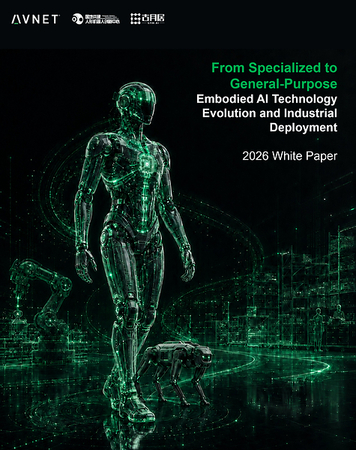
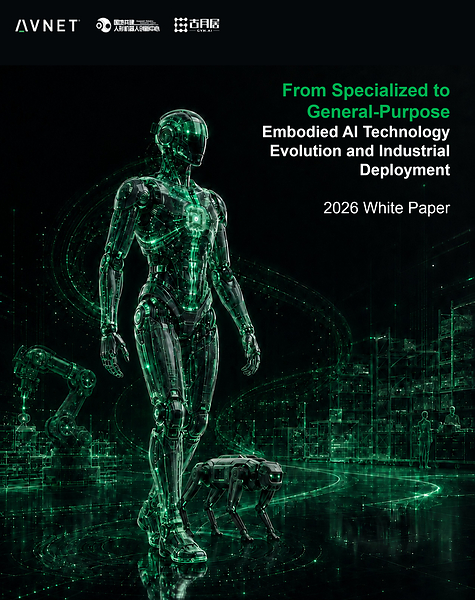
This is a central finding of From Specialized to General-Purpose: 2026 White Paper on Embodied AI Technology Evolution and Industrial Deployment, jointly published by Avnet, the National and Local Co-Built Humanoid Robotics Innovation Center and GYH.AI.
Embodied AI combines artificial intelligence with physical systems such as robots and autonomous machines, enabling them to perceive their surroundings, make decisions and act in the physical world. While advances in AI models, computing and robotics are accelerating innovation, broader adoption will depend on how effectively these technologies function as an integrated system.
"Much of the discussion around embodied AI today focuses on individual technologies, but the next stage of progress will depend on how well these technologies work together," said Edward Tsaur, VP, Avnet Design Services, Marketing & Communications, Asia Pacific. "The challenge is not just about making systems smarter. It is about ensuring they perform reliably, adapt to changing conditions and deliver consistent results over time."
The research identifies four factors that will influence the transition from specialized embodied AI applications toward broader industrial deployment:
・System integration is fundamental to performance. AI models, computing platforms, sensors, motion control, energy management and communications must function as a coordinated system. Weaknesses in any area can affect overall performance and reliability.
・Technology selection must reflect application requirements. Developers need to balance performance, energy efficiency, reliability, scalability and cost according to the intended task and operating environment. The most advanced individual component does not necessarily deliver the most effective overall solution.
・The path to general-purpose embodied AI will be gradual. Progress will build on specialized systems designed for defined tasks, with broader capabilities developing over time through advances in system architecture and integration.
・Industrial deployment requires lifecycle planning. Beyond initial functionality, organisations must consider testing, software compatibility, component availability, safety, maintenance and long-term support to ensure solutions remain practical and dependable in operational environments.
These findings highlight the importance of evaluating embodied AI not only by individual technology performance, but by how effectively complete systems perform useful tasks under actual operating conditions.
"Across Asia Pacific, we are seeing growing interest in intelligent systems for manufacturing, logistics, healthcare and other operational environments. For organisations exploring where embodied AI can deliver business value, the priority is to bring together technologies that meet defined requirements and can be deployed, scaled and maintained reliably," Tsaur added.
"Collaboration across the technology ecosystem will also be critical to translating advances in embodied AI into practical solutions. This means looking beyond individual components to consider how hardware, software and engineering expertise can work together to address specific needs."
As embodied AI moves toward broader industrial deployment, progress will increasingly depend on performance beyond controlled settings. Bringing system integration, application requirements and lifecycle considerations together from the outset will be essential to turning technological advances into deployable industrial solutions.
About Avnet
As a leading global technology distributor and solutions provider, Avnet has served customers' evolving needs for more than a century. Through regional and specialized businesses around the world, we support customers and suppliers at every stage of the product lifecycle.
We help companies adapt to change and accelerate the design and supply stages of product development. With a unique viewpoint from the center of the technology value chain, Avnet is a trusted partner that solves complex design and supply-chain issues so customers can realize revenue faster.
Learn more about Avnet at www.avnet.com.
PR Newswire Asia Ltd.

PR Newswire
1954年に設立された世界初の米国広報通信社です。配信ネットワークで全世界をカバーしています。Cision Ltd.の子会社として、Cisionクラウドベースコミュニケーション製品、世界最大のマルチチャネル、多文化コンテンツ普及ネットワークと包括的なワークフローツールおよびプラットフォームを組み合わせることで、様々な組織のストーリーを支えています。www.prnasia.com
本プレスリリースは発表元が入力した原稿をそのまま掲載しております。また、プレスリリースへのお問い合わせは発表元に直接お願いいたします。
プレスリリース添付画像


このプレスリリースには、報道機関向けの情報があります。
プレス会員登録を行うと、広報担当者の連絡先や、イベント・記者会見の情報など、報道機関だけに公開する情報が閲覧できるようになります。